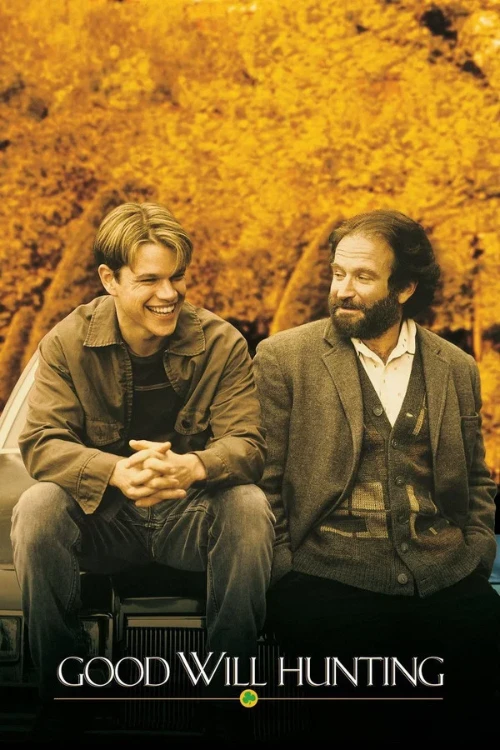
A touching tale of a wayward young man who struggles to find his identity, living in a world where he can solve any problem, except the one brewing deep within himself, until one day he meets his soul mate who opens his mind and his heart.
Directed by Gus Van Sant, Good Will Hunting (1997) stands as one of modern cinema’s most resonant explorations of raw intellectual gift burdened by deep emotional trauma. Written by Matt Damon and Ben Affleck, the Academy Award-winning screenplay uses Will Hunting’s mathematical genius not merely as a spectacle, but as a protective armor against genuine vulnerability. Set against the gritty, working-class backdrop of South Boston, the narrative cuts beneath the surface of intellect to expose how severe childhood neglect manifests as fear of intimacy, defensive cynicism, and self-sabotage.
The emotional core of the film rests on the transformative dynamic between Will and Dr. Sean Maguire, brought to life through a career-defining, Oscar-winning performance by Robin Williams. Their therapeutic encounters transcend clinical mechanics, evolving into an unfiltered philosophical dialogue on the divide between theoretical knowledge and lived human experience. The iconic park bench monologue perfectly encapsulates this distinction: knowing everything about art, war, or romance from books remains hollow without the lived courage to love deeply and endure loss. Williams’ understated empathy paired with Damon’s guarded intensity creates an electrifying authenticity.
Complementing this central mentorship is an exceptionally grounded portrayal of friendship, particularly through Chuckie Sullivan (Ben Affleck), whose loyalty is defined not by keeping Will tethered to their routine, but by wishing him a broader life beyond it. Good Will Hunting endures as a timeless masterwork because it resists melodramatic shortcuts, offering a moving reminder that true healing begins only when one finds the courage to accept that their trauma was never their fault.