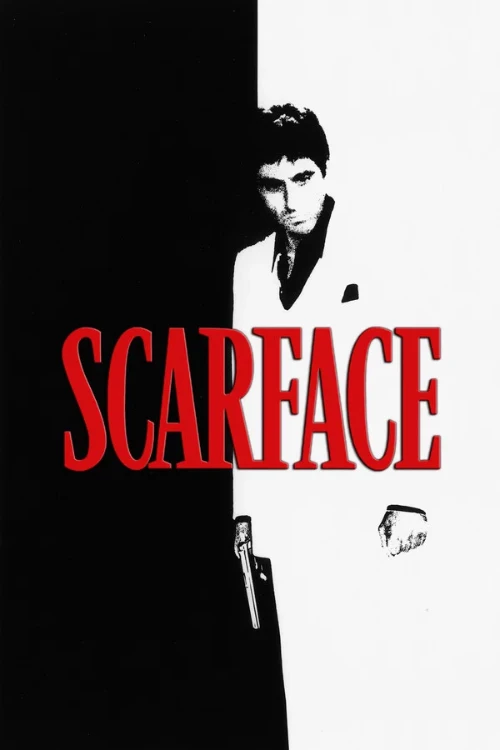
During the 1980 Mariel boatlift, Cuban refugee Tony Montana arrives at a Florida detention camp. Seeking a way out, his close friend Manny secures an opportunity for them to earn green cards by carrying out a contract hit. Tony quickly enters the ranks of drug kingpin Frank Lopez, proving his mettle and ruthless ambition when a deal with Colombian drug dealers turns bloody. While fiercely protective of his younger sister, his mother sees through his criminal lifestyle and disowns him. Driven by boundless greed and impatience, Tony eventually usurps Frank's empire and claims his mistress, Elvira Hancock. However, once at the pinnacle of power, his paranoia, violent excess, and outrageous actions paint a fatal target on his back, sending his empire crumbling down.
Directed by Brian De Palma and written by Oliver Stone, Scarface (1983) stands as one of cinema’s most visceral and unsparing deconstructions of the American Dream. Charting the meteoric ascent and catastrophic downfall of Tony Montana—a penniless Cuban refugee who aggressively carves out a cocaine empire in sun-drenched Miami—the film transcends traditional gangster tropes to deliver an operatic critique of unchecked ambition, greed, and 1980s excess.
Al Pacino commands the screen with a ferocious, larger-than-life performance, capturing Montana’s ruthless determination alongside the suffocating paranoia that consumes him at the summit of his power. De Palma’s stylish direction, accentuated by pastel aesthetics, lavish set pieces, and Giorgio Moroder’s pulse-pounding synth score, creates an intoxicating atmosphere where grandeur and moral decay collide. The extreme violence is never merely gratuitous; it acts as a direct reflection of a world governed solely by appetite and ego.
Scarface remains a cultural touchstone and a timeless cinematic tragedy that masterfully exposes the isolating, self-destructive cost of absolute power.