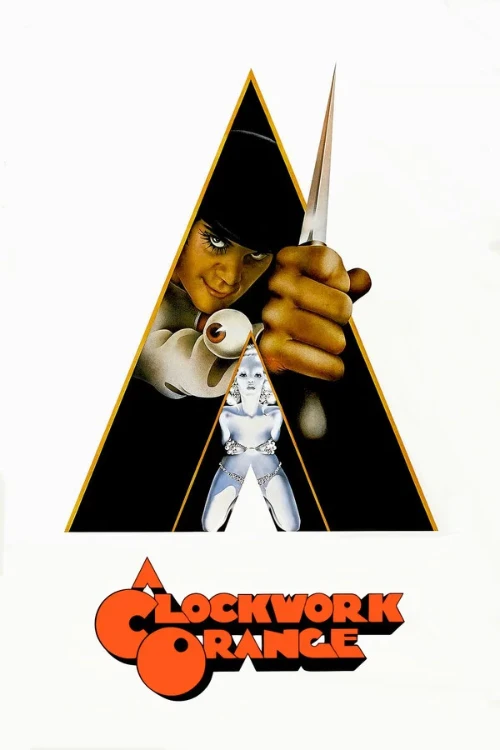
Stanley Kubrick’s 1971 masterpiece, A Clockwork Orange, adapted from Anthony Burgess’s novel of the same name, stands as one of the most provocative and impactful works in dystopian cinema. Set in a bleak near-future Britain, the film centers on Alex DeLarge, a charismatic yet sociopathic youth who, along with his gang of "droogs," engages in acts of stylized ultra-violence. Kubrick forces the audience to confront not only the horrific nature of individual depravity, but also the systemic cruelty of a state that seeks to erase human free will under the guise of institutional reform.
Visually and aurally, the film achieves a brilliant contrast that remains unparalleled. Pairing gruesome violence with classical compositions, particularly Beethoven’s Ninth Symphony, creates a deeply unsettling yet mesmerizing cinematic texture. The core philosophical conflict emerges through the Ludovico Technique—a psychological conditioning process designed to neutralize violent tendencies. This raises a profound moral question: if a person loses the capacity to choose evil, do they truly retain their humanity, or do they simply become a mechanized organism, a "clockwork orange"? Malcolm McDowell delivers a career-defining performance, capturing Alex’s terrifying charm and vulnerability with astonishing precision.
Ultimately, A Clockwork Orange remains a timeless critique of social control, state authority, and the delicate boundary between public safety and individual autonomy. With its brilliant cinematography, audacious storytelling, and enduring relevance, Kubrick’s vision continues to challenge and provoke audiences over half a century later.