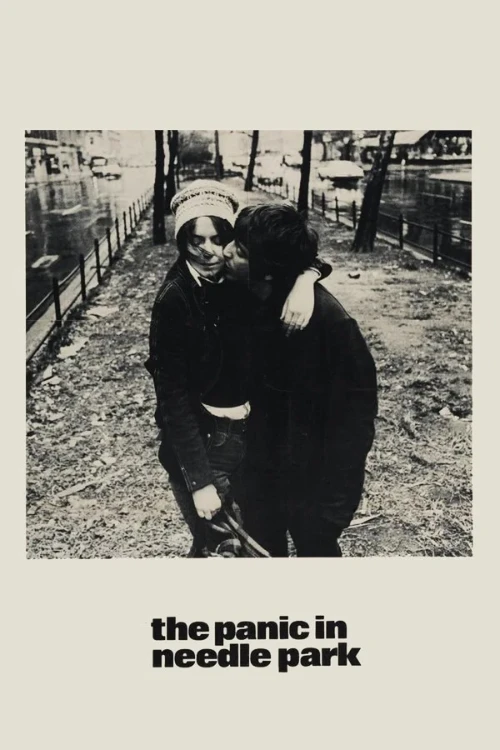
It's the upper west side of Manhattan in the area around Sherman Square, which is euphemistically called Needle Park for the propensity of intravenous drug use there. Bobby is a smaller time drug dealer and deludes himself that his own use is not an addiction. Helen is Marco's girlfriend, he one of Bobby's customers. It is through this connection that Bobby and Helen become friends, then more than just friends. Bobby exposes Helen to that drug use. Despite their continual declarations of love to each other and the want to get married, Bobby and Helen, by their actions, are more in love with heroin and the need to get the continual fix. Not having the temperament to keep a steady "traditional" job, Helen does whatever she needs to get the money for what has become her $80 per day fix. This fixation on the drugs for both Bobby and Helen may lead to an incompatible set of priorities, especially when the police get involved.
Directed by Jerry Schatzberg, "The Panic in Needle Park" (1971) stands as a gritty, unflinching portrait of heroin addiction set against the bleak urban landscape of New York City. Penned by Joan Didion and John Gregory Dunne, the screenplay intentionally shuns melodrama and romanticized tragedy, presenting an uncompromisingly realistic character study instead. Centered around Sherman Square—dubbed "Needle Park"—the narrative explores a desperate subculture spiraling into moral decay, particularly when a sudden supply shortage ("panic") hits the streets.
Marking Al Pacino's first leading role in a feature film, his performance as Bobby offers an early glimpse of his magnetic screen presence. Pacino effortlessly captures the dual nature of a charming yet utterly doomed young man navigating rock bottom. Opposite him, Kitty Winn delivers a remarkably nuanced, Cannes-winning performance as Helen, tracing the heartbreaking erosion of an innocent soul drawn into a codependent vortex. Their dynamic is less a conventional romance and more a mutual descent into isolation.
Atmospherically, the film embodies the raw aesthetic of the 1970s New Hollywood movement. Schatzberg's background in photography shines through the naturalistic framing, while the deliberate absence of a dramatic musical score allows the ambient sounds of the city to dictate the psychological tension. The movie refrains from preachy moralizing, opting instead for an intimate, documentary-like gaze into human vulnerability.