Gerald Ford
Personal Info
Gerald Ford
Biography
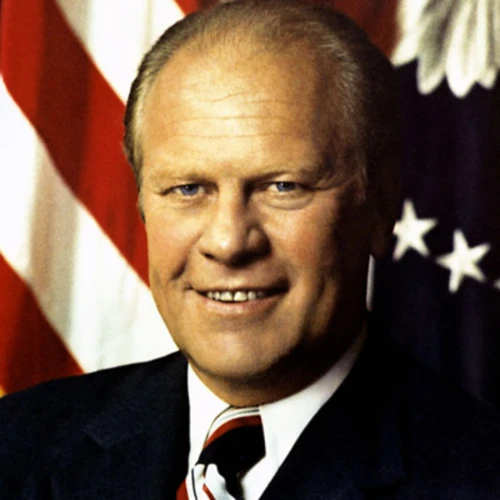
IMDb ↗Gerald Rudolph Ford served as the 38th President of the United States from August 1974 until January 1977. Born on July 14, 1913, in Omaha, Nebraska, as Leslie Lynch King Jr., he was the son of Leslie Lynch King and Dorothy Ayer Gardner King. His parents separated two weeks after his birth, and his mother took him to Grand Rapids, Michigan, to live with her parents. On February 1, 1916, his mother married Gerald R. Ford, a paint salesman. The couple began calling the young boy Gerald R. Ford Jr., though his name was not legally changed until December 3, 1935. At age 13, Ford learned that Gerald Sr. was not his biological father; however, it was not until 1930 that he met his biological father, Leslie King, who made an unexpected visit to Grand Rapids. Ford grew up with three younger half-brothers: Thomas, Richard, and James. He attended South High School in Grand Rapids, where he excelled as an athlete, earning induction into the honor society and selections to the 'All-City' and 'All-State' football teams. In November 1927, he achieved the rank of Eagle Scout. He earned money by working in the family paint business and at a local restaurant. From 1931 to 1935, Ford attended the University of Michigan at Ann Arbor. He majored in economics and political science, graduating with a Bachelor of Arts degree in June 1935. A standout player, he was a member of the university's national championship football teams in 1932 and 1933 and was voted the team's Most Valuable Player (MVP) in 1934. He also participated in All-Star and charity benefit games. Ford turned down contract offers from two professional football teams—the Detroit Lions and the Green Bay Packers—choosing instead to serve as a boxing coach and assistant varsity football coach at Yale University while pursuing his legal studies. He earned his law degree from Yale Law School in 1941. After returning to Michigan and passing the bar exam, Ford established a law partnership in Grand Rapids with Philip Buchen, a University of Michigan fraternity brother who would later serve as Counsel to the President in the Ford administration. In April 1942, Ford joined the U.S. Naval Reserve, working as a physical fitness instructor at a flight school in Chapel Hill, North Carolina. In the spring of 1943, he began active sea duty aboard the light aircraft carrier USS Monterey. Ford spent the remainder of the war on shore duty and was discharged with the rank of lieutenant commander in February 1946. Upon returning to Grand Rapids, he became a partner at the prestigious local law firm of Butterfield, Keeney, and Amberg. His initial foray into politics came in the summer of 1940 while working on Wendell Willkie's presidential campaign. Six years later, he challenged incumbent Bartel Jonkman for the Republican nomination to the U.S. House of Representatives in the 1948 election. Ford won the nomination and subsequently secured election to Congress on November 2, 1948, winning 61% of the vote. On October 15, 1948, during the height of the campaign, Ford married Elizabeth ('Betty') Anne Bloomer Warren, a department store fashion consultant. Betty was born on April 8, 1918, in Chicago, Illinois, and raised in Grand Rapids. The couple had four children: Michael Gerald (born March 14, 1950), John Gardner (born March 16, 1952), Steven Meigs (born May 19, 1956), and Susan Elizabeth (born July 6, 1957). Ford represented Michigan in the U.S. House of Representatives from January 3, 1949, to December 6, 1973. He was re-elected twelve times, consistently securing over 60% of the vote in each election. Aspiring early in the 1950s to become Speaker of the House, he declined several opportunities to run for the U.S. Senate and the Michigan governorship. In 1961, he was elected Chairman of the House Republican Conference. In 1963, President Lyndon B. Johnson appointed Ford to the Warren Commission to investigate the assassination of President John F. Kennedy; Ford would become the commission's last surviving member. In 1965, Ford was elected House Minority Leader, a position he held until 1973. In this role, he delivered over 200 speeches nationwide each year, gaining extensive national visibility. He remained a close personal friend and steadfast supporter of Richard Nixon in both the 1968 and 1972 presidential campaigns. Considered for the vice-presidential spot in 1960 and 1968, Ford was ultimately unable to achieve his goal of Speaker of the House due to the Republican minority. Instead, his subsequent appointment elevated him to President of the Senate as Vice President. In late 1973, Vice President Spiro Agnew pleaded no contest to felony tax evasion charges and resigned. Invoking the 25th Amendment, President Nixon nominated Ford to fill the vacancy, and Ford took the oath of office on December 6, 1973. On August 9, 1974, Nixon became the first U.S. president to resign from office amid the Watergate scandal and impending impeachment. That same day, Gerald R. Ford was sworn in as the 38th President of the United States. Later that month, Ford nominated Nelson Rockefeller as Vice President, a nomination confirmed by Congress on December 19, 1974. One month into his presidency, Ford made one of the most controversial decisions of his career by granting Nixon a full, free, and absolute pardon for any offenses committed against the United States during his presidency. The decision met with severe public backlash and sparked rumors of a pre-resignation deal, heavily contributing to Ford's narrow defeat in the presidential election two years later. On November 24, 1974, President Ford and Soviet General Secretary Leonid Brezhnev met at the Okeansky Sanatorium in Vladivostok, USSR, to sign a joint framework for the Strategic Arms Limitation Talks (SALT). In March 1975, during the closing stages of the Vietnam War, Ford authorized the airlift of approximately 237,000 Vietnamese refugees to the United States. Two months later, on May 14, 1975, he ordered military action to recapture the merchant vessel SS Mayaguez after its seizure by Cambodian forces—an action Ford labeled an act of piracy. Although the ship's 39 crew members were safely rescued, 41 American service members were killed and 50 wounded during the operation. Ford survived two separate assassination attempts during visits to California in September 1975, both carried out by female assailants. On September 5, 1975, Lynette 'Squeaky' Fromme, a follower of Charles Manson, attempted to shoot him in Sacramento. On September 22, 1975, Sara Jane Moore fired a shot at the President in San Francisco, but a bystander deflected the shot. Despite his athletic background, Ford suffered several public stumbles and falls during his presidency, though no medical causes were ever reported. At the August 1976 Republican National Convention, Ford narrowly held off a primary challenge from California Governor Ronald Reagan to secure the presidential nomination, choosing Kansas Senator Bob Dole as his running mate. Although Ford mounted a spirited campaign that significantly closed Democrat Jimmy Carter's wide polling lead, he ultimately lost the November 1976 general election in one of the closest contests in presidential history. Following his presidency, Gerald and Betty Ford retired to private life in Rancho Mirage, California. In retirement, Ford remained active in public discourse, lecturing at hundreds of colleges and universities. In 1981, the Gerald R. Ford Library in Ann Arbor and the Gerald R. Ford Museum in Grand Rapids were formally dedicated. He received numerous honors and honorary Doctor of Laws degrees throughout his later years. In August 1999, President Bill Clinton awarded Ford the Presidential Medal of Freedom, the nation's highest civilian honor. In October 1999, Congress presented Gerald and Betty Ford with the Congressional Gold Medal. Ford served as honorary Co-Chair of the National Commission on Federal Election Reform alongside Jimmy Carter in 2001, and in May of that year, he received the Profile in Courage Award for his decision to pardon Nixon. In his later years, Ford faced various health challenges. He suffered a mild stroke during the 2000 Republican National Convention in Philadelphia and underwent medical treatment in May 2003 after experiencing dizziness on a golf course. In June 2004, he attended the state funeral of Ronald Reagan at the Washington National Cathedral alongside fellow former presidents. In August 2006, he underwent angioplasty and had a cardiac pacemaker implanted at the Mayo Clinic in Rochester, Minnesota. On November 12, 2006, Ford surpassed Ronald Reagan to become the longest-lived president in U.S. history. He died at his home in Rancho Mirage, California, on December 26, 2006, at the age of 93 years and 165 days. Following a state funeral at the Washington National Cathedral on January 2, 2007, Ford was laid to rest on the grounds of his presidential museum in Grand Rapids, Michigan. He was survived by his wife of more than 58 years, Betty Ford, their four children, seven grandchildren, four great-grandchildren, and his brother Richard Ford.