Richard Nixon
Personal Info
Richard Nixon
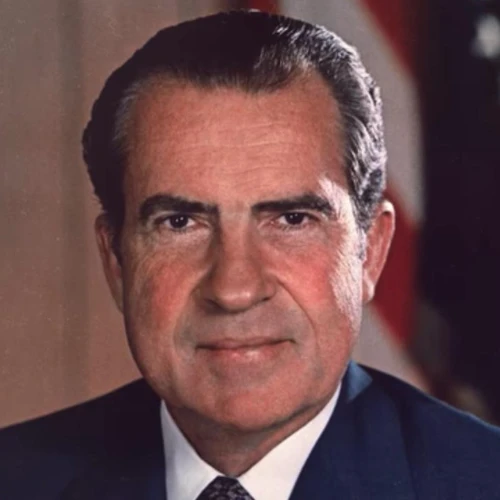
Biography
IMDb ↗Richard Nixon was born in Yorba Linda, California, where he grew up in modest circumstances and was raised in the strict Quaker tradition. An exceptional student at Fullerton High School, he received statewide recognition for his academic achievements. After graduating from Whittier College in 1934, he attended Duke University School of Law on a scholarship, graduating in 1937 and gaining admission to the California bar that same year. On June 21, 1940, Nixon married Patricia Ryan. Following a brief period working in law, he served as a naval officer during World War II, being discharged in 1946 with the rank of lieutenant commander. Entering politics as a Republican that same year, Nixon was elected to the U.S. House of Representatives, where he served from 1947 to 1950. In 1950, he won election to the U.S. Senate representing California, taking office in 1951. During his congressional tenure, he focused on addressing unemployment and poverty while balancing environmental concerns with economic growth. From 1953 to 1961, Nixon served as Vice President under Dwight D. Eisenhower. After Lyndon B. Johnson chose not to seek reelection in 1968, Nixon ran for the presidency, won election as the 37th President of the United States, and was inaugurated on January 20, 1969. In his high-profile campaign against narcotics, Nixon famously welcomed Elvis Presley to the White House in December 1970, presenting him with an honorary badge from the federal Bureau of Narcotics and Dangerous Drugs. Upon taking office, Nixon faced a nation deeply divided by the Vietnam War. Public trust in the administration eroded significantly following the publication of the Pentagon Papers—leaked Department of Defense documents published by The New York Times starting on June 13, 1971. These papers revealed that the U.S. government had misled the public regarding the 1964 Gulf of Tonkin incident, in which North Vietnamese patrol boats were reported to have attacked U.S. destroyers, an event that had catalyzed direct American military intervention. In domestic and science policy, Nixon launched the "War on Cancer" initiative in 1971 with the ambitious goal of finding a cure within 25 years. He also established key federal regulatory bodies, most notably the Environmental Protection Agency (EPA) in 1970. In foreign policy, Nixon made historic visits to the People's Republic of China and the Soviet Union in 1972, becoming the first sitting U.S. president to visit both nations and opening a new era of diplomatic détente. During his Moscow summit with Soviet leader Leonid Brezhnev, the two superpowers signed the landmark Strategic Arms Limitation Talks (SALT I) treaty. Working closely with National Security Advisor Henry Kissinger, Nixon secured a ceasefire agreement in January 1973, concluding direct U.S. military combat in Vietnam. That same year, his administration utilized shuttle diplomacy to de-escalate tensions following the Yom Kippur War in the Middle East. Nixon's presidency unraveled following the break-in at the Democratic National Committee headquarters at the Watergate complex in Washington, D.C. As congressional and judicial investigations revealed White House involvement in the subsequent cover-up, Nixon faced almost certain impeachment and removal from office. On August 9, 1974, he became the first U.S. president in history to resign from office. Vice President Gerald R. Ford succeeded him as president. Nixon withdrew from public life and retired to California, where he published his autobiography, RN: The Memoirs of Richard Nixon, in 1978. His wife, Pat Nixon, passed away in June 1993. After suffering a severe stroke, Richard Nixon died in New York City on April 22, 1994, at the age of 81.